

What Is the Yerkes-Dodson Law & How it Affects Your Motivation


Have you ever noticed that you perform better when there is a little bit of pressure? Maybe you feel more focused during a big game or sharper during a final exam.
While many people think all stress is bad, the truth is that a small amount of nervous energy can actually be your greatest tool. Success is not about being perfectly calm. It is about learning how to use your energy to reach your full potential.
What is the Yerkes Dodson Law?
The Yerkes Dodson Law is a famous psychological principle that is over a century old. It explains how your level of arousal affects how well you do a task. In this context, arousal simply means how alert or energised you feel.
Dr Akul Gupta, consultant psychiatrist at BetterPlace, explains that a little stress wakes the brain up, but too much stress overwhelms it. The law states that as you get more alert, your performance improves. However, this only works up to a certain point. If you become too stressed, your performance will start to drop. This is why being too bored can make you messy, and being too anxious can make you freeze, something people often confuse until they learn the difference between stress and distress.
Understanding the Yerkes-Dodson Law
The Relationship Between Arousal and Performance
You can think of your arousal level like a car engine. If the engine is idling too low, the car is sluggish and slow. If you rev it too high for too long, the engine might burn out. The arousal theory of motivation says that humans naturally look for a perfect level of stimulation. You do your best work when your internal engine is running at just the right speed, especially once you understand how much stress is too much stress and why it often creeps up quietly.
The Inverted U-Shaped Stress Curve
When you look at this idea on a graph, it forms an upside-down U shape. This is often called the stress curve. On the left side of the curve, you are bored, and your performance is low. As you move to the middle, you reach your peak performance. Once you pass that peak and move to the right, you become overwhelmed, and your performance falls again.
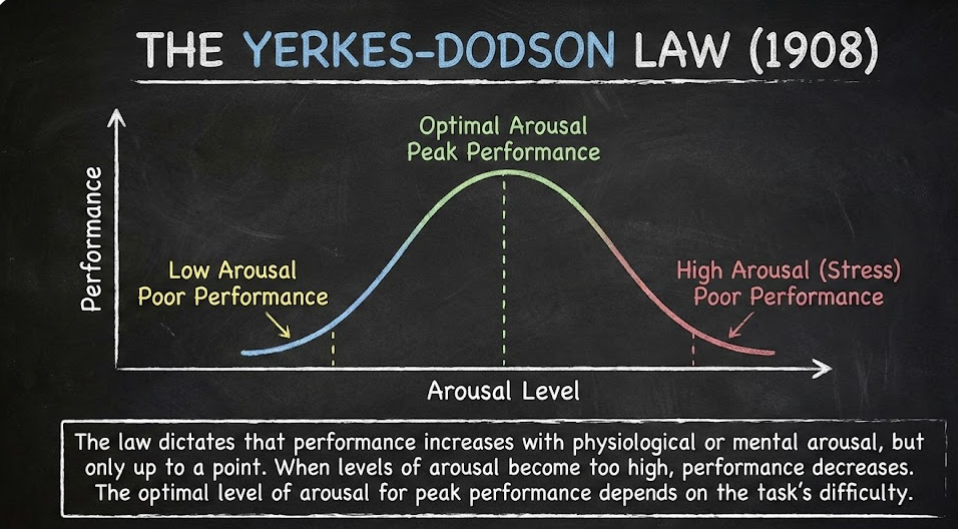
Dr Akul points out that your personality shapes your distress tolerance. Some people have a much narrower window of optimal arousal and reach overload faster. The good news is that experience widens your skill and lowers the amount of arousal you need. With practice, your brain becomes familiar with a situation, and you need less stress to feel prepared and confident.
When overwhelm becomes constant instead of situational, it can help to recognise what it looks like in daily life, like the signs described in what it means to feel overwhelmed.
Optimal Arousal Theory Explained
The optimal arousal theory tells us that this peak is different for everyone. What feels like an exciting challenge to you might feel like a scary situation to someone else. Dr Akul suggests that people recognise their optimal arousal through reflection, experimentation, and practice. If you are unsure where your peak lies, therapy can help you build distress tolerance and learn to regulate your emotions, especially if your stress is tangled with ongoing anxiety.
Simple vs Complex Tasks
The difficulty of what you are doing changes where your peak performance happens. For simple tasks that you have practised many times, a high level of arousal can actually help you. However, complex tasks that require deep thought or creativity need a lower level of arousal. If there is too much pressure, the difficult mental work becomes much harder to finish, often because the mind flips into loops that look like overthinking.
Practical Applications in Daily Life
Academic Performance and Study Habits
Trying to learn everything the night before an exam creates a lot of stress. While this might help you remember simple facts for a short time, it is a bad strategy for difficult theories. Dr Akul mentions that students often blank out not because they forgot everything, but because arousal passed the optimal point. High exam stress and hyperarousal drain cognitive energy and disrupt memory retrieval and focus. Poor sleep only worsens this problem, especially when you’re already dealing with not being able to sleep at night, or need practical steps on how to sleep fast.
Workplace Productivity and Stress
What is motivation in a work setting? Usually, it is the healthy pressure of a deadline or a goal. This pressure helps you stay engaged. The key is to recognise when this helpful pressure turns into bad stress. Dr Akul warns that constant urgency damages long-term performance. Continuous deadlines keep the body in a “fight or flight” mode, which leads to burnout. Using breaks and realistic timelines can help restore the curve to the optimal range.
In high-pressure roles, a psychologist in South Delhi can help you set better boundaries, reduce urgency-driven overwork, and rebuild performance without relying on stress as fuel.
When your body stays stuck in that activated state, quick regulation tools can help you come back down without losing focus, like the micro-interventions for anxiety and strategies for reducing anxiety immediately.
Sports and Physical Activities
A runner waiting for a race needs a huge burst of energy. That high level of arousal helps them move fast. On the other hand, a golfer needs to be very steady and calm to make a perfect shot. The best athletes know exactly how much energy they need for different activities.
Managing Anxiety Before Important Events
That nervous feeling before an interview is actually your body getting ready to perform. Dr Akul explains that trying to “calm down completely” often backfires because the nervous system does not switch off instantly.
These methods lower arousal without removing motivation. They regulate your nervous system and keep your mind anchored in the present while allowing useful alertness to remain.
- Mindfulness,
- Affirmations,
- Breathing exercises
- Muscle relaxation.
If anxiety is persistent (not just situational), or you’re seeing sleep/appetite changes and sustained distress, a psychiatrist in Gurgaon can assess whether you need a structured treatment plan alongside therapy tools.
Mastering Your Performance Through Arousal Management
Understanding the Yerkes-Dodson law changes how you approach challenges. Stop fighting your stress response and start working with it. Match your arousal level to the task at hand. Build self-awareness about where your personal peak lies. It takes practice. But when you nail it, the results speak for themselves.
FAQ's of Yerkes-Dodson Law
Through this lens, motivation is tied directly to how alert you are. Dr Akul explains that motivation rises with manageable stress, peaks at optimal arousal, and drops when stress becomes overwhelming. Optimal motivation happens in that productive middle zone where you are engaged but not panicked.
Learning requires your brain to be alert enough to focus but calm enough to think clearly. Moderate challenge helps learning, but high-pressure environments often make it hard to process difficult material. This explains why staying curious and relaxed often leads to better memory than stressed cramming sessions.
Yes, it can. Dr Akul notes that boredom reduces energy, curiosity, and attention. Being bored is just as bad for your performance as being panicked. Without enough arousal, your mind starts to wander and you may make simple mistakes. You need a little bit of a challenge to stay engaged and do your best work.


Anuroop Pokhriyal is a Content Specialist at BetterPlace Health. Before joining BetterPlace, he worked as a psychologist, content writer and marketer. He draws on his background in psychology to simplify complex mental health concepts and make them more accessible to readers. When he is not writing and optimising content, he enjoys playing badminton and making music.
Related Blogs